

Education, Training and Workforce Development
A productive semiconductor workforce needs to be well versed in diverse concepts originating from semiconductor materials, devices, circuits, architecture, EDA tools, packaging, power delivery, thermal management etc. For example, an engineer with computer engineering expertise developing the next generation of AI hardware needs to be well versed with packaging issues such as thermal management and reliability which are conventionally mechanical engineering domains. Historically semiconductor concepts are split across three undergraduate majors: Material Science MSE, Mechanical Engineering ME and ECE with little or no cross pollination during the undergraduate education. While semiconductor education has been offered by many colleges across the nation for decades, much of this learning experience is broken across artificial boundaries imposed by a student’s majors. For example, an undergraduate student in material science would be well trained in concepts related to semiconductor materials but would be minimally exposed to concepts in circuits, architecture and packaging. The same is true for students with mechanical engineering and ECE majors. While there may be some exceptions, overall the quality of undergraduate students entering the semiconductor workforce are devoid of a holistic learning experience needed to be a productive workforce. Moreover, lack of a holistic learning experience also impacts the undergraduate student’s motivation in pursuing a career in semiconductors.
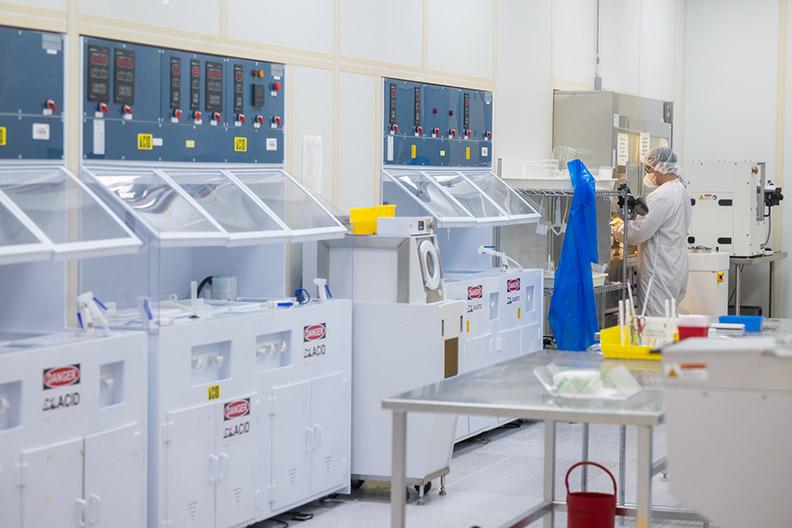
UMD is actively working to build a holistic training curriculum in semiconductors which provides a balanced learning experience across the diverse aspects of semiconductors including materials, devices, packaging, circuits, architecture and systems. We are advancing workforce development through a threefold approach.
1. Undergraduate education.
2. Graduate training.
3. Lifelong learning and industry-government training

This objective is being pursued through curricular and programmatic enhancement, training and workshop events, tutorials and other similar efforts. Some of our recent programs include:
1. Undergraduate minor in semiconductors (stay tuned for details).
2. MAGE Professional Masters in Engineering: https://mage.umd.edu/
a. Embedded Systems
b. ECE
c. Cybersecurity
d. Reliability Engineering
3. CALCE has several professional development courses in the semiconductors domains targeting working professionals: https://calce.umd.edu/professional-development-courses
Recent workforce development and training projects:
National Science Foundation
FuSe-TG:
Electro-Thermal Co-Design Center for Ultra-Wide Bandgap Semiconductor Devices:
https://www.nsf.gov/awardsearch/show-award/?AWD_ID=2234479
| Investigator | Role | |
|---|---|---|
| Sukwon Choi | Principal Investigator | sukwon.choi@psu.edu |
| Samuel Graham | Co-Principal Investigator | samuelg@umd.edu |
| Srabanti Chowdhury | Co-Principal Investigator | srabanti@stanford.edu |
| Sriram Krishnamoorthy | Co-Principal Investigator | sriramkrishnamoorthy@ucsb.edu |
| Christina DiMarino | Co-Principal Investigator | dimaricm@vt.edu |
Beginnings:
Democratizing Research and Experiential Education for Microelectronics:
https://www.nsf.gov/awardsearch/show-award?AWD_ID=2322699
| Investigator Name | Role | |
|---|---|---|
| Timothy K Horiuchi | Principal Investigator) | timmer@isr.umd.edu |
| Reza Ghodssi | Co-Principal Investigator | ghodssi@umd.edu |
| Pamela A Abshire | Co-Principal Investigator | pamela.abshire@stonybrook.edu |